

Introduction
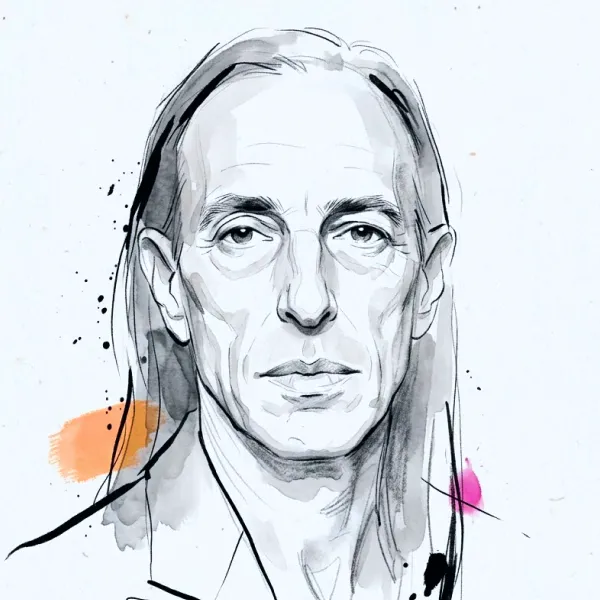
Rick Owens is an American fashion designer whose work has achieved global recognition for its singular, uncompromising aesthetic. After launching his eponymous label in Los Angeles in 1994, he moved to Paris, where he established a highly successful independent house. Owens is often referred to as the ‘Lord of Darkness’, a moniker that reflects his penchant for a somber palette and deconstructed forms.
His influence extends into furniture design and multiple diffusion lines, creating a comprehensive lifestyle brand alongside his wife and collaborator, Michèle Lamy. A multiple CFDA award winner, Owens has built a dedicated international following, positioning himself as a rare example of a commercially successful designer who remains outside the traditional fashion mainstream.
Design ethos
Aesthetic territory is defined by the concept of ‘grunge-glamour’, where sculptural, deconstructed silhouettes are rendered in a muted, dark palette. Inspiration is frequently drawn from architectural brutalism, land art, and ancient rituals, leading to garments that feel both primeval and futuristic. The work seeks to reconcile apparent opposites—such as order and chaos or the monumental and the fragile—resulting in a design language that prioritises a form of ‘simple complexity’.
The silhouette is typically elongated and draped, utilising bias-cut leathers and jersey to create forms that cling to or distort the body in unconventional ways. Significant emphasis is placed on the tactile quality of materials, which are often treated to appear weathered or industrial. Through the use of iconic elements like platform boots and exaggerated proportions, the work projects a sense of ceremonial gravity. This approach avoids conventional prettiness in favour of a powerful, often provocative, physical presence.
Disclaimer
Career history
2025
Temple is a retrospective-adjacent runway ritual rather than a museum footnote. At the Palais de Tokyo, scaffold staging and fountain immersion carry nylon, denim, silk taffeta, leather, sequins, sliced shorts, cropped jackets and fringed cloaks through water. The collection turns late Owens menswear toward authority, self-canonisation and physical exposure while staying separate from Temple of Love.
2024
Hollywood turns casting scale into the collection’s central device. Around 200 models cross the Palais de Tokyo esplanade in repeated looks, from white satin and crusted denim coatings to wrapped knits and metallic surfaces. The result links Owens’s Hollywood self-invention to civic spectacle, community and body accommodation rather than celebrity glamour.
2020
Phlegethon opens the Venice Lido menswear cycle, turning pandemic restrictions into format rather than limitation. Loose leather mesh, knits, swimwear, quilted shoulders, double-layer mesh tanks, masks and wader boots appear through a filmed shoreline presentation instead of an ordinary Paris runway. The Lido becomes a working stage for protection, reuse and intimacy under pressure.
2015
Cyclops makes women carrying women the central image and physical structure. Draped and strapped fabrics create doubled silhouettes, while the carried body changes balance, movement and meaning in real time. The show turns support, burden, dependence and female strength into visible construction, giving Owens one of his clearest statements about the social body.
2013
Vicious replaces the expected runway walk with step teams from four sororities, turning rhythm, synchrony and collective force into the show’s structure. Utilitarian tunics, shorts and movement-facing garments are made to stamp, shout and move in formation. It remains a decisive Owens moment because the runway becomes a social and physical event, not simply a sequence of looks.
2006
Presented at Pitti Uomo in Florence, Dustulator gives Rick Owens menswear its first secure institutional stage. Officer-like coats, long-john layers, voluminous shorts and a dust-stained military-sports mood carry the early Owens language into a male body system shaped by protection and exposure. The importance is not only seasonal: Florence turns the collection into a public menswear threshold for the house.
2005
DRKSHDW emerges in 2005 as the Rick Owens universe’s denim-and-jersey sub-brand, carrying the house’s long proportions, heavy footwear logic and shadowed palette into a more everyday register. Its importance is structural: DRKSHDW is not merely a secondary product category, but a parallel public language for jeans, sweats, sneakers and recurring collaborations outside the main runway.
1994
Rick Owens founded his label in Los Angeles in 1994, setting down a severe, tactile language built around leather, jersey, elongated proportion and a refusal of conventional polish. The later Paris runway, DRKSHDW, furniture and object-world branches all grow from this foundation: clothing as attitude, body structure and lived environment rather than a narrow seasonal product line.
You’re in
When the archive opens, you’ll be among the first to know.
That’s all.


