

Overview
20471120 was a Japanese fashion label founded in 1994 by Masahiro Nakagawa and Rika Azechi, known professionally as LICA, after two years working together under the precursor name Bellissima. Their partnership began in Osaka, where Nakagawa approached clothing as a self-taught conceptualist and LICA brought formal technical training and experience from a Kobe apparel company. Bellissima had been established in 1992, but a trademark conflict forced the founders to abandon the name in 1994. Nakagawa replaced it with the numerical sequence 20471120, derived from his private fixation on the date 20 November 2047; the mark used the phonetic reading Triventi for registration.
The renamed label moved quickly from regional independence into Tokyo fashion. Its formal Tokyo Collection debut came with Spring/Summer 1995, followed by a direct store in Jingumae that December. The founders did not model the house on the established Japanese designers who had conquered Paris through tailoring and textile innovation alone. 20471120 drew just as heavily from manga, tokusatsu, club culture, toys and the mechanics of mass entertainment. Nakagawa built concepts, characters and large narrative structures; LICA translated those ideas into garments that could function on the runway and in retail. Their combined authorship produced clothing in which transformation, distortion and play mattered as much as conventional luxury finish.
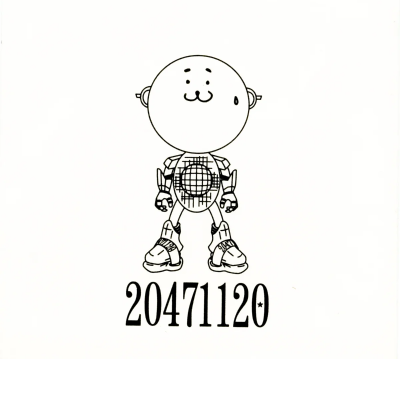
By the second half of the 1990s the runway had become a consumer spectacle. 20471120 sold tickets to presentations, opening fashion-show access beyond the usual press and buyer audience and helping finance increasingly ambitious staging. The house entered the Paris Collection in 1997 and developed HYOMA, a mascot whose shifting forms moved across clothing, accessories and merchandise. HYOMA was not a diffusion label: it functioned as character intellectual property inside the 20471120 world, closer to the logic of animation and toy culture than to a conventional secondary fashion line.
The house reached a cultural peak in 1998. Masahiro Nakagawa and LICA received the Mainichi Fashion Grand Prix Newcomer Award, while their presentation practice expanded into large-scale entertainment involving animation, vehicles, pyrotechnic effects and thousands of spectators. The same period also produced more introspective concepts such as LINK, shaped by LICA’s encounter with Inuit communities in Alaska. This tension between mass spectacle and personal connection became increasingly important as Nakagawa questioned the industrial cycle required to keep producing seasonal merchandise at scale.
Tokyo Recycle Project emerged from that tension around the turn of the millennium. Donated garments arrived with memories and personal histories, then were cut apart, recombined and returned as singular objects. The project did not instantly replace fashion. Its first numbered iteration was presented as 20471120’s Spring/Summer 2000 Tokyo Collection, and the label continued to appear in fashion contexts afterwards, including a Spring/Summer 2003 Tokyo Collection and a Spring/Summer 2004 Tokyo exhibition. At the same time, Nakagawa Sochi carried the recycle practice into museums and art exhibitions in New York, Yokohama, Washington and Sydney, creating an overlapping fashion-and-art structure whose institutional identity changed from event to event.
Regular 20471120 brand activity was suspended in 2006. The operating company, TRA I VENTI Inc., continued through other fashion and reuse ventures, while Nakagawa developed Nakagawa Sochi, Tokyo Recycle Project, painting and related art practices and LICA moved through Cacharel, Baby Jane Cacharel and zechia. The numerical label has subsequently survived through archives, resale culture and authorised-looking commercial activations. In 2025 beauty:beast and 20471120 released three limited collaborations using the name and HYOMA imagery, but no standalone seasonal house, dedicated retail operation or restored Nakagawa–LICA design partnership had re-emerged by 2026.
Philosophy
Transformation sits at the centre of 20471120. Nakagawa’s childhood fascination with Ultraman, kaiju and bodies that mutate from one state into another became a working principle for clothing. With no formal fashion education, he learned construction by dismantling second-hand garments and examining how they were made. That reverse-engineering mentality remained visible as the house moved from early surrealist references to computer-generated surfaces, character imagery and clothes built around alteration, disguise and recombination.
LICA supplied the technical counterweight to that conceptual approach. Her vocational training and commercial apparel experience gave the partnership a way to turn Nakagawa’s narrative systems into reproducible garments. The collaboration was not simply art direction handed to a technician. Institutional objects credit the pair jointly, and the house’s most recognisable work depends on a sustained negotiation between concept, pattern, material and the practical conditions of making clothing for a rapidly expanding audience.
20471120 also treated fashion as popular entertainment. Ticketed shows, animation, character merchandising and large live spectacles broke down the distance between an industry presentation and a consumer event. HYOMA made that approach portable. The character could migrate from a garment to a plush object, accessory or electronic product without losing its identity, allowing fashion, toy collecting and visual storytelling to share the same world. This was a different model of brand recognition from the single logo or signature textile: the audience followed a cast of images and mutations.
The runway scale of the late 1990s was matched by a growing suspicion of endless production. Tokyo Recycle Project redirected the house’s interest in transformation towards existing garments and the memories held inside them. Clothes were collected with personal testimony, dismantled and recomposed, making the owner’s history part of the design material. The method replaced identical units with singular objects and moved authorship closer to exchange between designer and participant.
This recycle practice also altered the boundary between fashion and art without making either category disappear immediately. Spring/Summer 2000 placed recycling inside the Tokyo Collection, while later iterations operated through Nakagawa Sochi at MoMA PS1, the Yokohama Triennale, the Smithsonian Folklife Festival and the Powerhouse Museum. 20471120 could therefore exist as a seasonal label, a character universe and a point of entry into participatory art at the same time. The instability of those categories is part of the house’s history instead of a problem to be smoothed away.
The post-suspension afterlife preserves the same logic in reduced form. HYOMA and the numerical name retain enough visual identity to return through limited collaborations long after the original seasonal structure stopped. Those releases depend on recognition of an existing archive instead of on the creation of a new standalone house. The durability of 20471120 lies in this transferable visual system: garments, characters, recycled objects and performance formats can reappear in new contexts while remaining legible as fragments of the same 1990s Japanese experiment.
Timeline
Disclaimer
Creative timeline
Button Text20471120 related structures
The label’s architecture extended beyond a conventional seasonal clothing line, but its best-known extensions did not all function as independent fashion divisions.
Tokyo Recycle Project
- Tokyo Recycle Project
- reconstruction and participatory art practice • begun around 1999
- Led by Masahiro Nakagawa, the numbered recycle series collected worn garments together with their owners’ memories and rebuilt them as singular objects. The first numbered iteration entered the Spring/Summer 2000 20471120 Tokyo Collection; later projects increasingly appeared under Nakagawa Sochi in museums and international art settings.
HYOMA
- HYOMA
- character intellectual property • developed from 1997
- HYOMA was the house mascot and visual character system, appearing on clothing, accessories, plush objects and collaborative products. It should be understood as intellectual property within 20471120, not as a separate diffusion label or autonomous fashion brand.
20471120 collaborations and commissions
The house moved easily between fashion, consumer products, performance and contemporary art, with collaboration often extending an existing character or transformation idea into another medium.
Fashion, product and image
- Pioneer × 20471120
- HYOMA portable CD player • 2000
- A limited portable CD player developed with Pioneer turned HYOMA into an electronic fashion accessory, extending the house’s character system beyond clothing and conventional merchandise.
- beauty:beast × 20471120
- limited collaborative releases • 2025
- Three limited releases returned the 20471120 name and HYOMA imagery to new products. The collaboration belongs to the label’s archive and intellectual-property afterlife and did not restore a standalone seasonal operation.
Art and institutional projects
- Takashi Murakami / SUPERFLAT
- exhibition context • 2000–01
- 20471120 and Nakagawa Sochi entered the early Superflat exhibition circuit, placing character-driven fashion and recycle work inside a broader account of contemporary Japanese art and consumer culture.
- Matteo Messervy
- spatial and light collaboration • 2000
- The Being’s figures installation extended the house’s interest in bodies and transformation into environmental and light-based work.
- Laurent Moriceau
- Yokohama Triennale project • 2001
- The Triennale archive records a joint identity combining Moriceau, 20471120 and Nakagawa Sochi alongside Tokyo Recycle Project activity.
- Jenny Kee / Tokyo Recycle Project #15
- Powerhouse Museum, Sydney • 2005
- Nakagawa Sochi’s recycle practice worked with Jenny Kee and participant garments at The Cutting Edge: Fashion from Japan, creating unique reconstructed clothing inside a museum setting.


