

Introduction
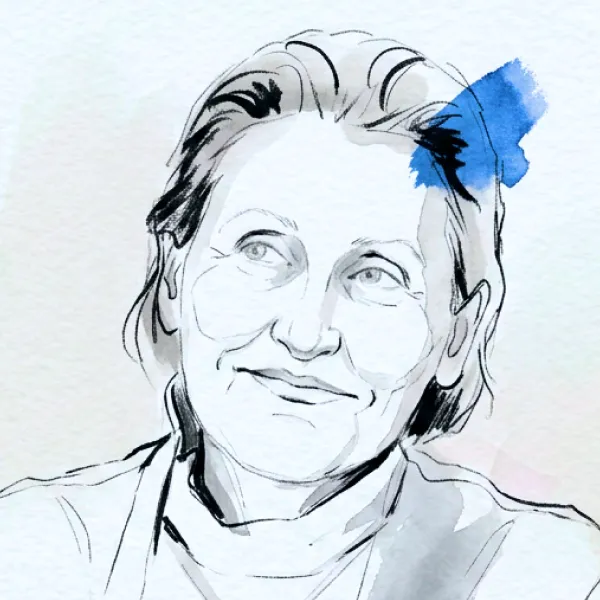
Adeline André is a French couturier, born in Bangui in 1949, who founded her Paris house in 1981. She trained at the École de la Chambre Syndicale de la Couture Parisienne and began her professional career at Christian Dior, assisting during Marc Bohan’s tenure across haute couture, accessories and the expanding Miss Dior ready-to-wear context.
After work connected to Louis Féraud, Jean-Charles de Castelbajac, Promostyl and Créateurs & Industriels, André established her own house with interior designer István Dohár. Her three-sleeve-hole garment was registered with the INPI in 1981 and WIPO in 1982. The construction became the basis of a wider practice concerned with wrapping, folding and garments whose final form depends on the wearer’s movement.
André joined the official Paris couture calendar as an invited member in 1997 and became a permanent member in 2005. Alongside seasonal made-to-measure collections, she has developed performance costumes, sensory research garments and exhibitions, and has taught colour at the École de la Chambre Syndicale.
Design ethos
André begins with the behaviour of cloth on a moving body. She removes shoulder pads, heavy interfacing, ordinary zips and unnecessary internal structure, relying instead on bias cutting, wrapping and exact control of grain. The line appears spare because the technical work has been absorbed into the cut.
Her three-sleeve-hole system turns the arm into a fastening and allows one piece to close in several ways. The Robe Repliable, twenty-one-sleeve garment and Robe Book extend this logic through repeated folds, shared layers and modular organza sections. These works do not use transformation as a novelty; they make dressing itself part of the construction.
Natural materials remain decisive. Cashmere, silk, linen, wool and cotton are selected for weight, memory, transparency and response to colour. André’s minimalism is therefore tactile and kinetic: the garment is resolved when material, body and movement reach equilibrium.
Disclaimer
Career history
2024
A 2024 exhibition at Can in Vienna focused on two garments that condense André’s construction research: the layered Robe Repliable and the modular Robe Book. Presented outside the fashion-week cycle, the works were treated as systems of fold, connection and bodily movement rather than seasonal looks.
2017
From 2017, André’s stage work became a continuing extension of the couture practice. Costumes for Set and Reset/Reset and later projects with Angelin Preljocaj used loose construction, rotation and fabric response to register choreography in real time. The theatre made visible the same relationship between cut, gravity and motion that governs her private-client clothes.
2012
In 2012, André was appointed Chevalier of the Légion d’honneur. The distinction followed more than three decades of independent fashion work, permanent haute couture membership, teaching and performance costume.
2010
From around 2010, André taught colour at the school where she had trained. The role formalised a pedagogical strand already visible in her work: colour was treated as a material condition shaped by fibre, dye, light and movement rather than as surface decoration.
2005
SmartSecondSkin connected André’s idea of clothing as a responsive membrane to scent technology developed with Jenny Tillotson. Micro-tubing integrated into cloth was designed to circulate aromatic liquids around the body in response to emotional or physiological cues, extending couture construction into sensory and medical research.
2005
ADELINE ANDRE SA formalised the operating company behind the couture house in 2005. Registered in Paris, the structure supports the atelier, private-client work and official calendar activity while leaving creative leadership with André. Its formation coincided with the house’s elevation to permanent haute couture membership.
2005
In January 2005, Adeline André was elevated from invited status to permanent membership of the Chambre Syndicale de la Haute Couture. The designation recognised the atelier’s made-to-measure practice and granted the house the protected haute couture appellation. It remains listed by the FHCM as a Haute Couture Member.
1998
From the late 1990s, André developed a continuing group of garments built through folding, repeated openings and detachable sections. The Robe Repliable layered metres of bias-cut organza into a compact epidermis; the twenty-one-sleeve performance exposed the same logic through progressive unwinding; Robe Book later connected organza envelopes through flaps and buttonholes. Together, the projects extended the original patent into an open-ended construction programme.
1997
In May 1997, the Chambre Syndicale admitted Adeline André as an invited member. Her first official couture-calendar collection followed at the Fondation Cartier for Autumn/Winter 1997–98. A dress from the season entered the French national collection, joining calendar recognition to an early institutional acquisition.
1995
Adeline André received ANDAM recognition in 1995. The award acknowledged an independent practice that had survived outside the conventional wholesale system and was consolidating its bespoke identity before joining the official couture calendar.
1987
From the late 1980s, limited commercial infrastructure made conventional wholesale difficult to sustain. André concentrated increasingly on made-to-measure work and direct client relationships. Between roughly 1992 and 1996, the Topofwear salons formalised this model through small private presentations, fittings and orders outside the standard runway cycle.
1983
Beginning with the 16 March 1983 presentation at Galerie Daniel Templon, André showed clothes inside art spaces with models moving among guests. The format continued through the 1980s and removed the raised catwalk, allowing viewers to examine cut, interior finish and movement at close range.
1981
André registered the three-sleeve-hole garment with the INPI in 1981 and extended protection through WIPO in 1982. Three arm openings allow cloth to wrap and secure itself around the body without ordinary buttons or zips. The construction made the wearer’s movement part of the fastening system and became the clearest technical signature of the house.
1981
Adeline André co-founded her Paris house in 1981 and remains its artistic director. She guided the practice from experimental ready-to-wear and gallery presentations towards a small, made-to-measure couture atelier. The house is defined by soft construction, natural fibres, minimal internal structure and garments whose form changes through the wearer’s movement.
1976
In 1976, André produced a collection under her own name through Didier Grumbach’s Créateurs & Industriels platform. The project preceded the formal house and placed her within a Paris network testing new forms of designer-led production outside established couture maisons.
1973
After Dior, Adeline André worked in positions connected to Louis Féraud, Jean-Charles de Castelbajac and Promostyl before presenting under her own name. This career record is brand-neutral.
1970
Adeline André joined Christian Dior as an assistant during Marc Bohan’s tenure, working across haute couture, accessories and Miss Dior ready-to-wear. The role exposed her to fittings and specialised ateliers before her later independent practice.
1968
André studied at the École de la Chambre Syndicale de la Couture Parisienne from 1968 to 1970. Classical pattern cutting and couture construction gave her the technical command later required to remove padding, linings and visible fastenings from her own work. Drawing sessions associated with Salvador Dalí also reinforced her understanding of dress as volume around the body.
1966
Before entering couture, Adeline André studied photography in London. The period sharpened her attention to bodies, framing and movement before she shifted from observing clothes through the camera to constructing them around the wearer.
You’re in
When the archive opens, you’ll be among the first to know.
That’s all.


