

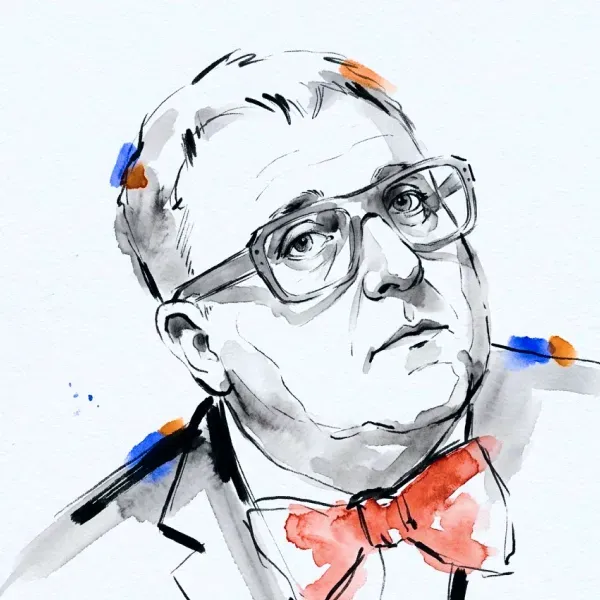
Introduction
Alber Elbaz was a Moroccan-born Israeli fashion designer whose career moved from an extended New York apprenticeship to leadership roles in Paris and Milan. Raised in Holon and trained at Shenkar, he settled in New York in 1985; from 1989 to 1996 he worked as Geoffrey Beene’s assistant before leading women’s ready-to-wear at Guy Laroche, Saint Laurent Rive Gauche and, briefly, Krizia Top.
Elbaz joined Lanvin in October 2001 and presented his first collection for the house in March 2002. Over the next fourteen years he rebuilt the women’s studio around drape, light construction and close atelier exchange, then carried that language through accessories, stores and image. His authority centred on women’s ready-to-wear; Lucas Ossendrijver maintained a distinct menswear studio from 2005.
After Lanvin’s majority shareholder ended his tenure in October 2015, Elbaz returned through selected collaborations and a 2019 venture with Richemont. That partnership became AZ Factory, launched in January 2021 as a digitally led house built around modular wardrobes, technical knitwear and a broad size range. Elbaz died on 24 April 2021, three months after the launch.
Design ethos
Elbaz treated ease as a construction problem rather than a casual effect. Draped lengths, pleating, soft understructures and asymmetric fastening allowed garments to sit close to the body without rigid corsetry; raw hems, basting, grosgrain, exposed zips and cords left parts of the making visible.
The clothes were designed for movement and for a wearer dressing without assistance. At Lanvin this produced lightly engineered dresses, adjustable wraps and jewellery used as part of the silhouette. AZ Factory translated the same logic into machine-washable technical knits, modular switchwear and sizing from XXS to 4XL.
Image and product were continuous concerns. Hand-drawn figures, ribbon, costume jewellery, colour and mise-en-scène carried the studio’s visual language across clothing, packaging and presentation, while specialist collaborators retained their own category authorship.
Disclaimer
Career history
2021
The Alber Elbaz tribute turned Paris Fashion Week into an unusually collective act of industry mourning.
2021
Alber Elbaz's death left a major creative and emotional void that shaped the rest of the year.
2019
Alber Elbaz and Richemont announced their AZfashion venture in October 2019; it became AZ Factory and launched during Paris Haute Couture Week in January 2021. As founder and creative director, Elbaz built the house around modular wardrobes, AnatoKnit, broad sizing and direct digital distribution. His death on 24 April 2021 ended the founding tenure after its first product stories.
2015
Lanvin ended its collaboration with Alber Elbaz on 28 October 2015 following a decision by the majority shareholder. His Spring/Summer 2016 collection had already been presented and was delivered after the end of his authority.
2015
Fashion Group International presented Alber Elbaz with its Superstar Award on 22 October 2015. In his acceptance speech he criticised the accelerating fashion system and the displacement of design by image production; six days later Lanvin announced the end of his tenure.
2015
Alber Elbaz / Lanvin: Manifeste assembled more than 350 photographs of fittings, backstage labour, garments and runway spectacle at the Maison Européenne de la Photographie. It documented the studio system shortly before Elbaz’s departure.
2013
Lancôme released its limited-edition makeup collaboration with Alber Elbaz worldwide on 15 June 2013. Elbaz supplied the illustrated packaging and visual concept as an individual designer; the project was separate from Lanvin’s fragrance and beauty rights.
2007
The Couture Council of the Museum at FIT selected Alber Elbaz of Lanvin for its 2007 Award for Artistry of Fashion, presented in New York on 5 September. The honour recognised his design work rather than a separate collection or institutional role.
2005
The Council of Fashion Designers of America gave Alber Elbaz its 2005 International Award during his fourth year at Lanvin, marking American industry recognition of the women’s ready-to-wear programme he had rebuilt in Paris.
2001
Alber Elbaz joined Lanvin in October 2001 to lead women’s ready-to-wear and presented his first collection on 9 March 2002. Over fourteen years he rebuilt the women’s studio around drape, light construction and atelier exchange, extending its language through accessories and image while Lucas Ossendrijver retained distinct menswear authority. The majority shareholder ended Elbaz’s tenure on 28 October 2015.
2000
Krizia appointed Alber Elbaz head womenswear designer in August 2000, assigning him the luxury Krizia Top line and collaboration with Mariuccia Mandelli on the main ready-to-wear. He left after three months, following the October debut of his first and only Krizia Top collection.
1998
Elbaz took operational responsibility for the women’s Rive Gauche collections in November 1998 while Saint Laurent retained couture and Slimane retained menswear. He presented three runway seasons before Ford’s takeover of women’s ready-to-wear was confirmed on 2 March 2000.
1996
Ralph Toledano recruited Alber Elbaz in September 1996 to direct Guy Laroche’s women’s luxury ready-to-wear after the suspension of formal couture. Elbaz studied the archive and introduced change gradually across four public seasons, restoring press and buyer attention before completing his final collection in October 1998. His contract ended on 31 October, after his appointment to Saint Laurent Rive Gauche had already been announced.
1989
Introduced to Geoffrey Beene through Dawn Mello in 1989, Alber Elbaz worked as Beene’s assistant until 1996. The seven-year apprenticeship placed him inside a New York studio built on exact cutting, movement and light construction, training that remained visible in his later work.
You’re in
When the archive opens, you’ll be among the first to know.
That’s all.


