

Introduction
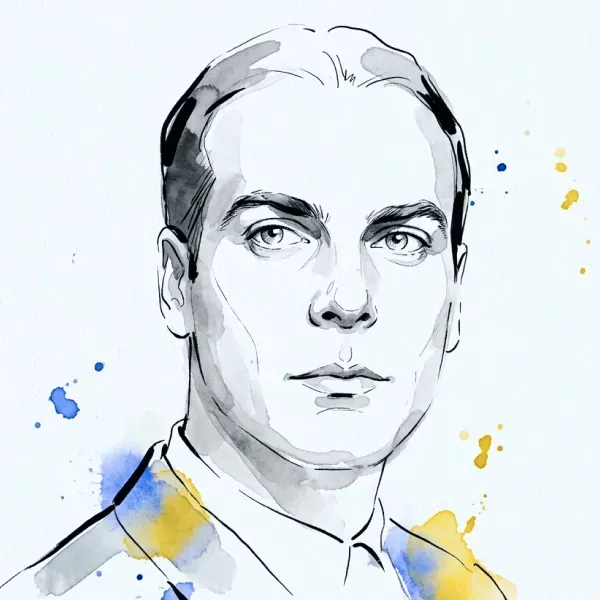
Cristóbal Balenciaga Eizaguirre was a Spanish couturier and the founder of Balenciaga. Born in Getaria on 21 January 1895, he trained through tailoring and dressmaking in San Sebastián before opening C. Balenciaga in 1917. Spanish salons followed in Madrid and Barcelona, while the Civil War prompted his move to Paris, where he opened at 10 Avenue George V in 1937.
Balenciaga possessed an unusually complete command of couture construction: he could draft, cut, drape, fit and sew, allowing him to alter silhouette from within rather than decorate an inherited shape. The barrel line, semi-fitted suit, balloon jacket, tunic, sack dress, baby-doll, one-seam coat and envelope dress progressively loosened the waist and placed air between fabric and body. He closed the house in 1968 rather than convert it into industrial ready-to-wear, and died in Spain on 24 March 1972.
Design ethos
Balenciaga began with the textile. Weight, grain, stiffness and fall determined the form, while the toile became a technical map for eliminating unnecessary seams and controlling volume with darts, folds and bias. He often suspended garments from the shoulders or pelvis, freeing the waist and allowing the silhouette to stand independently of the wearer’s anatomy.
His collaboration with Abraham textile director Gustave Zumsteg produced silk gazar, whose crisp memory made late architectural forms possible without heavy internal scaffolding. Spanish religious dress, court portraiture and regional costume supplied colour and atmosphere, but the enduring force of the work lies in its construction: severe line, exact sleeves, controlled backs and a refusal to let ornament compensate for weak structure.
Disclaimer
Career history
1968
Cristóbal Balenciaga closed the house in 1968, ending garment production rather than compromising his couture system for ready-to-wear.
1959
Balenciaga’s final decade reduced couture towards one-seam construction, severe capes, Empire lines and freestanding gazar forms, culminating in the Envelope dress and the decision to close rather than adopt industrial ready-to-wear.
1956
Balenciaga and Hubert de Givenchy delayed press access to their collections in 1956, protecting designs from rapid copying and openly challenging the established couture presentation calendar.
1947
Across the barrel line, semi-fitted suit, balloon jacket, tunic, sack and baby-doll dress, Balenciaga moved fabric progressively away from the body and made air, suspension and ease part of couture structure.
1947
In 1947 Balenciaga introduced the barrel line, an early break from the fitted waist, and launched Le Dix, the house’s first fragrance, named for its Avenue George V address.
1937
The first Paris decade translated Spanish court portraiture, ecclesiastical dress, regional costume and bullfighting references into couture built from dense velvet, lace, embroidery and controlled volume.
1937
Displaced by the Spanish Civil War, Balenciaga opened his Paris couture house at 10 Avenue George V in 1937 with financial backing from Nicolas Bizcarrondo and Wladzio d’Attainville.
1927
Balenciaga opened Martina Robes et Manteaux in 1927 and quickly renamed it EISA Costura, creating a second Spanish label that broadened the business and helped protect the main salon from copying.
1917
Balenciaga developed his tailoring practice in San Sebastián, formed and dissolved Balenciaga y Compañía, opened EISA, expanded to Madrid and Barcelona, and used licensed Paris designs to deepen his command of modern cutting.
1917
Cristóbal Balenciaga opened C. Balenciaga in San Sebastián in 1917, establishing the business from which the Spanish salons, EISA and the later Paris house developed.
You’re in
When the archive opens, you’ll be among the first to know.
That’s all.


