

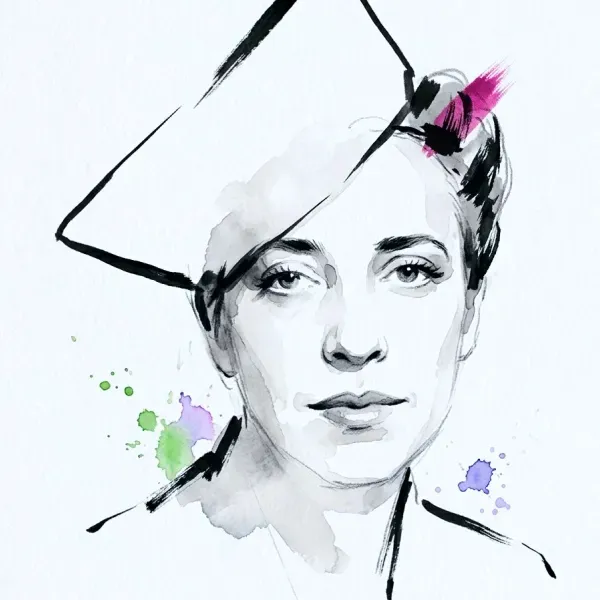
Introduction
Elsa Schiaparelli was an Italian-born French couturière who founded one of interwar Paris’s most inventive fashion houses. Born in Rome in 1890, she reached fashion through literature, philosophy, the New York avant-garde and a formative Paris period that included encouragement from Paul Poiret and salaried design work at Maison Lambal. Her independent business began in 1927 with graphic knitwear shown from her apartment and was formalised later that year with Charles Kahn’s investment.
The trompe-l’œil bow sweater established the operating method that would define her career: Schiaparelli supplied the image and commercial direction, while Aroosiag Mikaëlian engineered the Armenian knitting technique that made it possible. As the house expanded from sportswear to full couture and moved to 21 Place Vendôme, Schiaparelli commissioned artists and specialist makers for garments, jewellery, interiors, fragrance bottles and advertising. Salvador Dalí, Jean Cocteau, Meret Oppenheim, Leonor Fini, Jean Schlumberger and Maison Lesage belonged to that network, but their roles varied from concept and product design to technical execution.
Schiaparelli left occupied Paris in 1940, returned in 1945 and continued to direct the house until its financial collapse in December 1954. Her influence rests not on a single Surrealist look but on a broader model of creative direction: thematic collections, cross-disciplinary commissions, licensing and the deliberate conversion of art-world ideas into clothing and objects. She died in Paris in 1973.
Design ethos
Schiaparelli approached dress as an intellectual and visual proposition rather than as an exercise in conventional good taste. Trompe-l’œil allowed a flat surface to imitate volume; ordinary objects changed scale or function; anatomy, astrology, insects, food and machinery became structures for clothing. The effect could be comic, unsettling or elegant, but it was rarely arbitrary.
Her silhouettes joined strong shoulders, narrow lines and exact tailoring to strategic disruption. Divided skirts altered the social reading of sportswear, visible zips made industrial hardware decorative, and wartime pockets turned utility into design. In eveningwear, transparent plastics, intense colour and narrative embroidery shifted attention across the body, often making ornament behave like an argument rather than a finishing touch.
The work was collaborative by construction. Schiaparelli drew, commissioned and edited, while knitters, embroiderers, textile specialists, jewellers and artists solved the material problem. That division of authorship was not incidental to the house; it was the mechanism through which an impossible sketch became a stable sweater, an embroidered profile or a padded skeleton.
Disclaimer
Career history
1973
Elsa Schiaparelli died in Paris on 13 November 1973, aged eighty-three. Her death severed the founder’s remaining personal relationship to the licensed name and preceded the transfer of the European apparel rights to Guido Sassoli de Bianchi, who would attempt a couture revival later in the decade.
1945
Elsa Schiaparelli returned to Paris in 1945 and resumed direct control of the house. Postwar collections pursued architectural drape, hard tailoring and unconventional accessories while the boutique expanded separates and licensed goods. Falling couture sales and mounting debt narrowed the operation before bankruptcy closed the Place Vendôme house in December 1954.
1927
Elsa Schiaparelli began showing independent knitwear from her Paris apartment in 1927 and formalised the business later that year. She expanded from sportswear into full couture, moved the house to 21 Place Vendôme and developed a thematic collection system built through commissions to artists and specialist makers. Her direct pre-war leadership ended when she left occupied France for the United States in July 1940.
You’re in
When the archive opens, you’ll be among the first to know.
That’s all.


