

Introduction
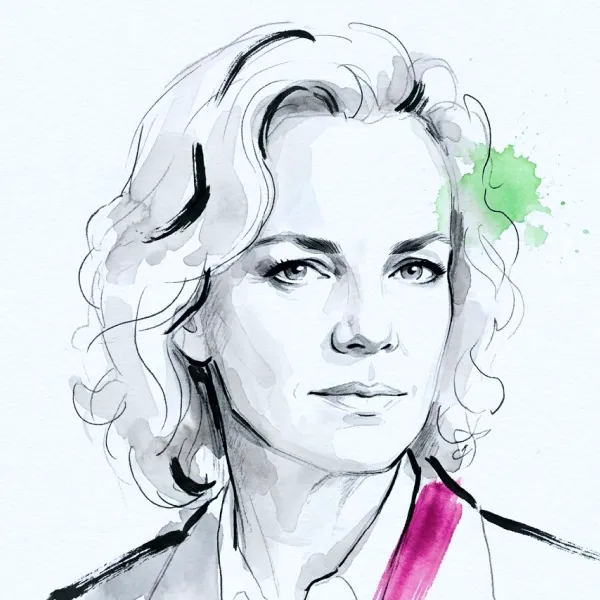
Jil Sander, born Heidemarie Jiline Sander in 1943, is a German designer and the founder of the house that bears her name. After textile-engineering studies in Krefeld, an exchange period in California and editorial work for German women’s magazines, she opened a boutique in Hamburg in 1968 and presented her first eponymous collection there in 1973.
Sander built an international business around exact tailoring, advanced textiles and an unadorned wardrobe for women entering professional life on new terms. Fragrance, Milan shows, international retail and menswear extended that system before Prada acquired control in 1999. She left the company in 2000, returned from 2003 to 2004, returned again from 2012 to 2013 and maintained a clear distinction between her authorship and the ownership of the label.
Outside the house, her +J work with UNIQLO brought the same attention to fabric, proportion and industrial production to a mass-market collaboration across two cycles. Her career remains central to the history of European minimalism, but its force lies less in absence than in the sustained engineering of cloth, cut and use.
Design ethos
Sander works by removing visual noise until construction and material become legible. Jackets are balanced through shoulder, lapel and length; trousers and coats create authority without theatrical hardness; colour is controlled so that surface, weight and movement can carry the garment.
Textile development is integral to that method. Technical cloth, fine wool, double-face construction and precisely finished basics allow apparent simplicity to hold considerable labour. The wardrobe is modular and durable, designed to support the wearer’s movement and professional presence rather than impose a seasonal character.
Her minimalism is therefore neither neutral nor purely formal. It is a discipline of decision: fewer elements, more exact relationships and a direct connection between quality, function and emotional confidence.
Disclaimer
Career history
2013
Jil Sander left the house for personal reasons on 24 October 2013. The company assigned the next collections to its in-house team, ending the founder’s last documented creative tenure.
2012
Jil Sander returned under Onward on 28 February 2012, first presenting menswear that June and womenswear in September. The concise tenure restored founder authorship under a different owner before ending in October 2013.
2004
The company and Jil Sander announced the end of their renewed cooperation in November 2004 after failing to agree on the economic and strategic plan. The departure reopened a period of studio-led authorship.
2003
Jil Sander returned with immediate effect on 20 May 2003 under a new creative contract and a strategic role within Prada. Her first product was a small men’s range in June, followed by a full women’s runway return that October.
2000
Jil Sander announced her resignation from company leadership on 25 January 2000 after strategic conflict with Prada. Her final pre-exit women’s presentation followed on 24 February, separating the executive break from the last collection boundary.
1968
Jil Sander opened her Hamburg boutique in 1968 and developed it into an eponymous house, presenting the first women’s collection in 1973. Her initial creative tenure established the label’s precision tailoring, material research and reduced modern wardrobe before her first departure in 2000.
You’re in
When the archive opens, you’ll be among the first to know.
That’s all.


