

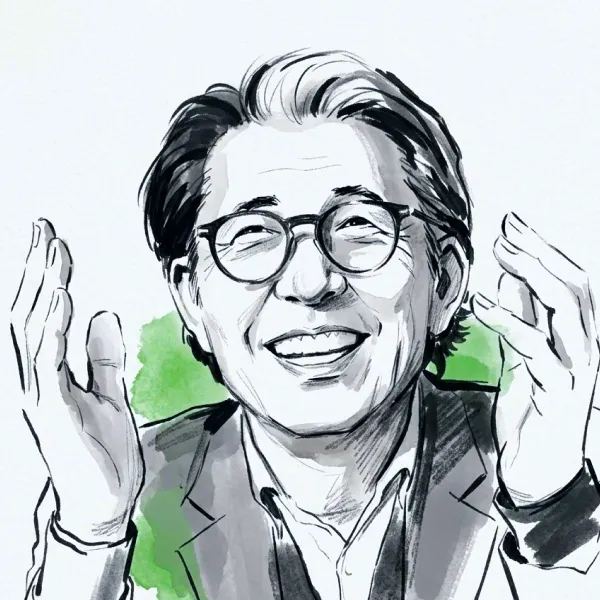
Introduction
Kenzo Takada was the Japanese founder who established the Paris house now known as Kenzo. After studying at Bunka Fashion College and arriving in Paris in 1965, he opened a boutique in Galerie Vivienne in 1970 under the name Jungle Jap. The eponymous Kenzo identity emerged across the middle of that decade, as the business moved from an improvised shopfront to a larger base at Place des Victoires.
Takada expanded the house through womenswear, menswear and a network of licensed categories while preserving a recognisable language of ease, pattern and movement. LVMH acquired the company in 1993, and he remained its central creative author until his retirement at the end of 1999, marked by a large retrospective show at the Zénith in Paris.
His death in Paris in October 2020, from complications associated with COVID-19, closed a life that had changed the terms on which a Japanese designer could build an independent house in the French capital. Later Kenzo directors repeatedly returned to his archive, not as a fixed template but as a working source of colour, volume and cultural exchange.
Design ethos
Takada cut for motion. Wide sleeves, generous trousers, layered tunics, wraps and soft tailoring loosened the body from the rigid line of much Paris fashion, while checks, florals and stripes were mixed at a scale that made pattern part of the silhouette rather than surface decoration.
His references moved between Japanese dress, European folk costume, workwear and travel without collapsing into a single theme. Early runway imagery shows that synthesis through kimono-like volumes, blanket coats, ponchos, tiered skirts, tartans and exuberant florals, often animated by models who danced rather than walked with conventional formality.
The house's pleasure was structural as well as chromatic: clothes were designed to be combined, reversed, belted and worn with latitude. Spectacle supported that proposition, from circus-like staging to the Place des Victoires tent and the 1999 farewell, but the enduring idea remained practical freedom expressed through cloth.
Disclaimer
Career history
2020
Kenzo Takada died in Paris on 4 October 2020, aged 81, from complications associated with COVID-19. The loss returned attention to the independence of his 1970 foundation and to the archive that continued to shape the house long after his 1999 retirement.
1999
On 7 October 1999, Kenzo staged a large retrospective farewell at the Zénith in Paris alongside the Spring/Summer 2000 collection. The event gathered three decades of house imagery into a public act of succession before Takada's year-end retirement.
1999
Takada announced his retirement on 10 September 1999 and completed his founder-led tenure at the end of the year. The departure prompted a category split rather than an immediate appointment of one successor, with Gilles Rosier taking womenswear and Roy Krejberg menswear.
1993
Louis Vuitton SA announced the acquisition of Kenzo on 2 August 1993 in a transaction reported at about $80 million. Takada remained creative leader, so the deal changed ownership and operating scale without immediately ending founder authorship.
1987
The menswear line introduced in 1983 was formally identified as Kenzo Homme in 1987. The naming created a durable category identity that later supported separate design leadership during the post-founder succession.
1986
Kenzo Jeans and Kenzo Jungle were introduced in 1986 as distinct extensions of the fashion business. Together they carried the house into denim and younger diffusion categories before the end of the founder era.
1984
Album by Kenzo launched with the American retailer The Limited in 1984. The line placed a controlled version of the house's colour and layering into a broader distribution system, marking an early attempt to separate licensed reach from the principal Paris collection.
1983
Takada introduced a dedicated menswear collection in 1983. The new category extended the house's loose volumes, print and cultural mixture without simply reducing womenswear shapes, and it later acquired the formal Kenzo Homme identity.
1981
Kenzo's 1981 show beneath a tent at Place des Victoires condensed the founder's approach to presentation: clothing, movement and a temporary public environment were designed as one experience. The format helped establish theatrical hospitality as a durable house code.
1977
A Kenzo presentation at Studio 54 in 1977 carried Takada's showmanship into New York nightlife. Performance, music and social energy became part of the house's international image rather than incidental decoration around the clothes.
1976
Kenzo moved to 3 place des Victoires in 1976, replacing the intimacy of Galerie Vivienne with a headquarters and retail address capable of supporting a rapidly expanding international business. The site became closely associated with the founder era and later housed distinctive runway staging.
1975
The transition to the Kenzo name was gradual rather than a single-day rebrand. The eponymous label was securely visible by Spring/Summer 1975, while the earlier identity persisted in some contexts until 1977.
1971
The house's original name became the subject of legal and public dispute in the early 1970s. The dispute accelerated the move towards the eponymous Kenzo identity; the offensive historical wording is relevant only to the circumstances of that transition.
1970
Takada remained the house's defining creative author from its 1970 foundation through the end of 1999. Across three decades he developed a language of movement, pattern and cultural combination, expanded into menswear and licensed categories, and maintained design authority after the 1993 LVMH acquisition.
1970
After securing premises in Galerie Vivienne at the end of 1969, Kenzo Takada opened his Paris boutique in 1970 under the historical name Jungle Jap. The founding collection was assembled with limited means from fabrics sourced at the Marché Saint-Pierre, establishing the mixture of print, looseness and improvisation that would define the early house.
You’re in
When the archive opens, you’ll be among the first to know.
That’s all.


