

Introduction
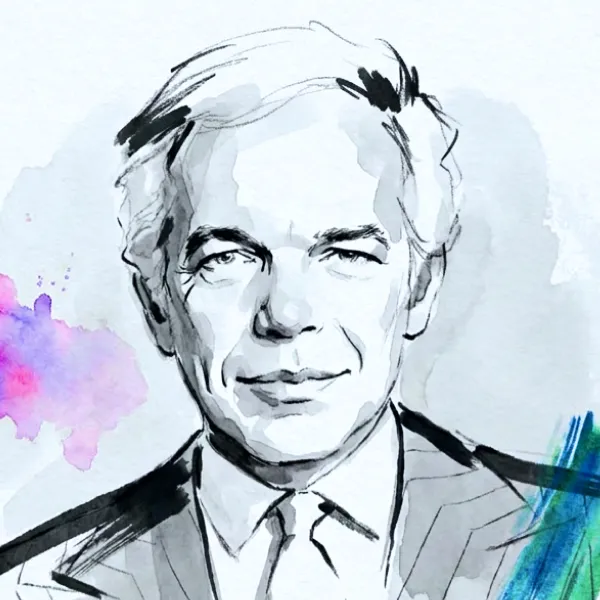
Ralph Lauren is an American designer and founder of the Ralph Lauren fashion house, born in the Bronx in 1939. He began with men’s ties in New York in 1967 and built that first Polo business into one of the most legible American fashion universes: tailored menswear, women’s Collection, Polo sportswear, Purple Label, Double RL, home, fragrance, hospitality and a dense image-world of country houses, city clubs, Western landscapes, sport and old Hollywood polish.
His authorship is unusual because it is less attached to a single silhouette than to a complete lifestyle grammar. Lauren turned aspiration, memory and social codes into a commercial and cultural system: the polo shirt, the navy blazer, the tweed jacket, the cowboy boot, the evening gown, the rugby stripe, the club room and the ranch all become parts of the same long-running fiction of American style.
Lauren stepped back from the chief executive role in 2015 but remained the company’s Executive Chairman and Chief Creative Officer. For TFDB, he should be treated as the primary creative author of Ralph Lauren rather than as one entry in a normal chain of creative directors; the public record does not support replacing that authorship with a continuous list of internal designers.
Design ethos
Ralph Lauren’s design ethos is built around romanticised American classicism. Prep, Ivy League tailoring, Western dress, English country clothing, sporting uniforms, Art Deco glamour and cinematic eveningwear are not used as isolated references; they are arranged as a complete social world. The clothes often appear familiar because Lauren’s method depends on recognised codes, but the effect comes from how precisely those codes are staged, polished and repeated.
The strongest Ralph Lauren collections are rarely about rupture. They work through atmosphere, styling, material hierarchy and narrative continuity: tweed with denim, tuxedo with baseball cap, ranchwear with evening satin, nautical whites with luxury tailoring. His language gives American fashion a form of mythmaking that is conservative in vocabulary but expansive in scale.
That consistency can be mistaken for simplicity. In practice, Lauren’s system is a sophisticated exercise in brand authorship: clothing, interiors, retail, restaurants, campaigns and runway locations all reinforce the same idea of taste as a lived environment. The design proposition is not only what to wear, but what world the wearer appears to inhabit.
Disclaimer
Career history
2026
Ralph Lauren is listed for two live menswear show slots during Milan Moda Uomo SS27 on 19 June 2026 at Via San Barnaba 27.
2026
Ralph Lauren presented Purple Label and Polo Ralph Lauren for Fall 2026 at Palazzo Ralph Lauren during Milan menswear, making the house’s Milan strategy newly visible after a long gap.
2024
Ralph Lauren presented Spring 2025 Collection, Purple Label and Polo Ralph Lauren in Bridgehampton, turning the Hamptons into a runway, hospitality and brand-world setting.
2018
Ralph Lauren’s 50th-anniversary event at Central Park’s Bethesda Terrace combined runway, dinner and digital installation into one of the brand’s most public statements of American fashion memory.
2015
After the 2015 CEO transition, Ralph Lauren continued to lead the company’s vision as Executive Chairman and Chief Creative Officer.
2007
Ralph Lauren staged a 40th-anniversary runway show and black-tie event in Central Park’s Conservatory Garden, consolidating the house’s taste for cinematic American spectacle.
1995
Purple Label launched as Ralph Lauren’s top-tier menswear line, concentrating luxury tailoring, fine fabrics and the house’s European-meets-American menswear ideal.
1993
Double RL launched as a heritage workwear and Western line named after Ralph and Ricky Lauren’s ranch, giving the Ralph Lauren universe a distinct denim, ranchwear and archival Americana pillar.
1983
Ralph Lauren Home expanded the house from clothing into a fully staged lifestyle environment, making interiors central to the brand’s fashion identity rather than an unrelated side business.
1972
Ralph Lauren’s first full women’s collection established the womenswear current later framed through Ralph Lauren Collection and its long-running runway archive.
1967
Ralph Lauren began the business in New York in 1967 with a Polo neckwear line, establishing the root identity from which the Ralph Lauren fashion house and Polo universe developed.
You’re in
When the archive opens, you’ll be among the first to know.
That’s all.


