

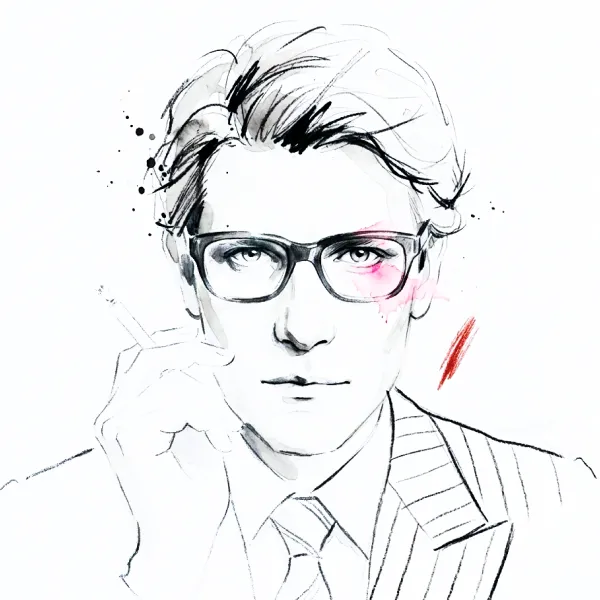
Introduction
Yves Saint Laurent was a French couturier born in Oran, Algeria, whose career moved from Christian Dior’s studio to one of the defining independent houses of the twentieth century. He arrived in Paris in 1954, joined Dior as an assistant on 20 June 1955 and was formally appointed artistic director of the haute couture house on 15 November 1957. Across six Dior collections he developed from the expansive Trapèze line to the tighter, youth-oriented final season of 1960.
After his Dior contract was broken in 1961, Saint Laurent founded a new Paris house with Pierre Bergé, opening publicly on 4 December and presenting the first collection the following January. He directed haute couture and oversaw the growth of Saint Laurent rive gauche, the ready-to-wear venture founded in 1966 with Bergé and Didier Grumbach. His work was developed through a durable internal structure led by Studio director Anne-Marie Muñoz, accessories and knitwear designer Loulou de La Falaise, couture director Hélène de Ludinghausen and specialist ateliers and manufacturers.
Saint Laurent delegated menswear to Hedi Slimane in the 1990s and women’s ready-to-wear to Alber Elbaz in 1998 while retaining haute couture. He presented his final conventional couture season in July 2001, announced retirement in January 2002 and closed the couture house that October. The Fondation Pierre Bergé–Yves Saint Laurent later assumed stewardship of the archive. Saint Laurent died in Paris on 1 June 2008.
Design ethos
Saint Laurent repeatedly transferred garments associated with male authority into women’s dress. The pea coat, trench, safari jacket, trouser suit and tuxedo were not isolated novelties but parts of a wardrobe in which sharp tailoring gave the wearer composure, mobility and public presence. He balanced those structures with sheer blouses, narrow evening lines and exposed skin, making control and vulnerability operate in the same look.
His collections also treated art, theatre and historical dress as working material. Mondrian geometry became blocked jersey construction; Russian, Chinese, Spanish, Moroccan and sub-Saharan references were translated through colour, embroidery, print and silhouette; Claude Lalanne’s body jewellery and Maison Lesage embroidery entered the clothes as authored specialist work. The strongest results retained the specificity of those techniques instead of using reference as decoration alone.
Saint Laurent’s practice depended on the movement between couture and industrial ready-to-wear. Couture allowed exact fitting, complex surface and singular objects, while Rive Gauche tested how the same propositions could survive standard sizing, repeated manufacture and daily use. That dual system made his contribution broader than a list of famous garments: it changed how a couture author could structure a modern fashion house.
Disclaimer
Career history
2002
Saint Laurent announced on 7 January 2002 that he would stop designing. The announcement ended his active mandate but did not substitute for the retrospective farewell on 22 January or the couture house’s legal and operational closure on 31 October.
1966
Saint Laurent co-founded Rive Gauche and supplied its principal design authority from the 1966 launch until women’s ready-to-wear passed to Alber Elbaz in late 1998. The line translated some couture propositions while also developing through its own industrial and retail requirements.
1961
Yves Saint Laurent co-founded the independent house with Pierre Bergé and held final creative authority from its public opening on 4 December 1961. He directed haute couture through the 2002 closure, oversaw Rive Gauche from 1966 and later delegated menswear and women’s ready-to-wear to named successors.
1960
Yves Saint Laurent left Dior in 1960 after six collections when National Service interrupted the tenure and Marc Bohan replaced him. Later accounts add a disputed management narrative, but the call-up and succession are secure.
1960
Military service and hospitalisation removed Saint Laurent from Dior’s daily operation in autumn 1960, when Marc Bohan was installed as successor. The employment contract was not legally resolved until May 1961, separating the operational end of the tenure from the later contractual rupture.
1957
Saint Laurent was formally designated artistic director of Christian Dior’s haute couture house on 15 November 1957 and led six seasonal collections. He was operationally displaced during military service in autumn 1960; Dior’s non-performance of his fixed-term contract became a legal rupture in May 1961.
1955
Christian Dior hired Yves Saint Laurent on 20 June 1955 after Michel de Brunhoff showed the couturier his sketches. Saint Laurent became Dior’s first and only assistant before being designated successor in 1957.
1955
Christian Dior hired Yves Saint Laurent as an assistant on 20 June 1955. Dior’s July 1957 letter credited him with 34 of 180 designs in the founder’s final collection, establishing material studio responsibility while the public collection credit remained Christian Dior.
You’re in
When the archive opens, you’ll be among the first to know.
That’s all.


