

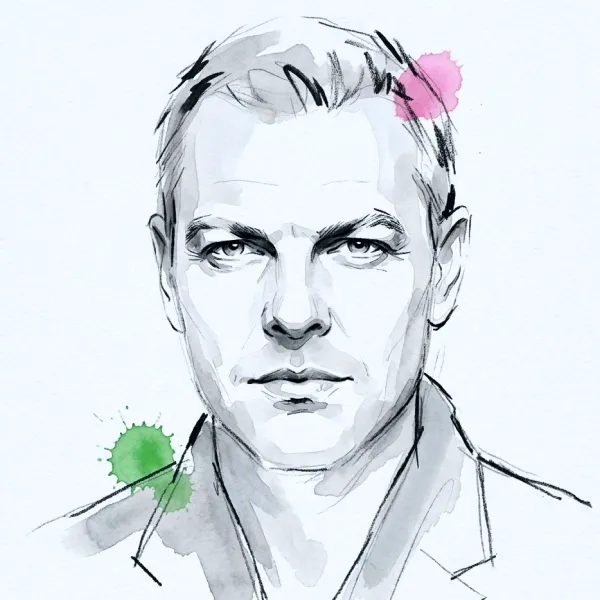
Introduction
Jonny Johansson is a Swedish designer, musician and entrepreneur who co-founded the ACNE creative collective in Stockholm in 1996 and remains the creative director of Acne Studios. Born in Ronneby in 1969 and raised in Umeå, he first pursued music before moving into retail, graphic work and the collaborative advertising culture from which ACNE emerged.
Johansson’s 1997 experiment with one hundred pairs of red-stitched raw denim redirected the collective towards fashion. He developed the Acne Jeans operation and, with business partner Mikael Schiller, concentrated the company around Acne Studios in the early 2000s. Under his continuing authorship, the label moved from Stockholm denim to London and Paris runways while expanding into womenswear, menswear, accessories, publishing, retail architecture and fragrance.
His role extends beyond the seasonal collections. Johansson oversees Acne Paper, artist relationships, stores and image-making, maintaining a working culture in which verbal exchange and multidisciplinary research can move between commercial wardrobe pieces and more unstable runway propositions.
Design ethos
Johansson describes his approach as maximalist minimalism. He begins with recognisable garments—jeans, blazers, aviator jackets, shirts and knitwear—then disturbs them through excessive scale, compression, awkward placement or a material that changes how the form is read.
Contrast is central to the work. Distressed denim and heavy leather meet silk, lace, faux fur and formal checks; bourgeois and preppy codes are interrupted by punk, rave, queer styling and Nordic craft. The result is rarely minimal in effect, even when the underlying construction is clean.
He also uses branding and collaboration as design materials. Pale pink packaging, the neutral Face motif, Acne Paper and artist-built show environments reflect an interest in ideas initially considered too ordinary, unattractive or culturally misplaced. Their value comes from how precisely they are reframed within the wider Acne Studios system.
Disclaimer
Career history
2025
Acne Studios converted its former Palais Royal boutique into Acne Paper Palais Royal in 2025. The permanent gallery created a public programme for exhibitions, books, talks and new work by contributors associated with the publication.
2024
Acne Studios entered fragrance in 2024 through Editions de Parfums Frédéric Malle. Perfumer Suzy Le Helley developed a floral aldehydic scent that set clean-laundry effects against peach, vanilla and sandalwood.
2021
Acne Paper returned in 2021 in an expanded book format after a seven-year pause. The relaunch renewed the publication as a substantial cultural project rather than a seasonal brand supplement.
2019
Acne Studios moved its global headquarters into Floragatan 13, a former Czechoslovak embassy in Stockholm. The preserved brutalist building and commissioned furniture made the workplace a permanent expression of the company’s architectural and cultural interests.
2018
IDG Capital and I.T Group acquired a combined 41 per cent minority stake in Acne Studios in 2018. Jonny Johansson and Mikael Schiller retained a controlling majority, using the investment to support international growth without surrendering independent control.
2017
The Face motif expanded into a permanent unisex collection on 17 August 2017. The neutral expression became a recognisable casual product system associated with the Swedish concept of lagom.
2017
Acne Studios relaunched its denim offer as Blå Konst on 6 April 2017. Permanent fits and seasonal studies gave denim a dedicated structure described by Jonny Johansson as a free space parallel to the main collections.
2015
Acne Studios introduced a complete eyewear collection in 2015, extending the accessory business through frames that used exaggerated scale, colour and simplified graphic construction.
2014
The original run of Acne Paper ended in 2014 after fifteen issues. The pause closed the first phase of the publication without ending Acne Studios’ wider use of art, photography and print.
2013
An invitation connected to the Palais Galliera enabled Acne Studios to present its womenswear in Paris in 2013. The calendar move established the house within the city’s international runway system while retaining its Stockholm base.
2010
Acne Studios opened its first United Kingdom store on Dover Street in 2010. The retail expansion accompanied the house’s first London Fashion Week presentation and made London its first major runway stage outside Sweden.
2006
The fashion operation separated from the wider ACNE company network and consolidated its identity as Acne Studios. The restructuring concentrated ownership, investment and international growth around fashion while retaining Acne Paper and other cultural projects.
2005
Acne Studios launched Acne Paper as a thematic cultural publication spanning photography, art, literature, history and fashion. Its editorial distance from seasonal product advertising became a defining part of the house’s multidisciplinary identity.
1997
The response to Acne’s first small denim project gave the collective a viable fashion business and led to the Acne Jeans phase. The structural change established clothing as the activity that would later become Acne Studios.
1996
Jonny Johansson co-founded ACNE in 1996 and developed its experimental fashion activity into Acne Studios. He remains the house’s creative director and principal design author.
1996
Jonny Johansson, Mats Johansson, Jesper Kouthoofd and Tomas Skoging founded ACNE in Stockholm in 1996 as a multidisciplinary company spanning advertising, film, graphic design, digital projects and fashion. The original name meant Associated Computer Nerd Enterprises.
You’re in
When the archive opens, you’ll be among the first to know.
That’s all.


