

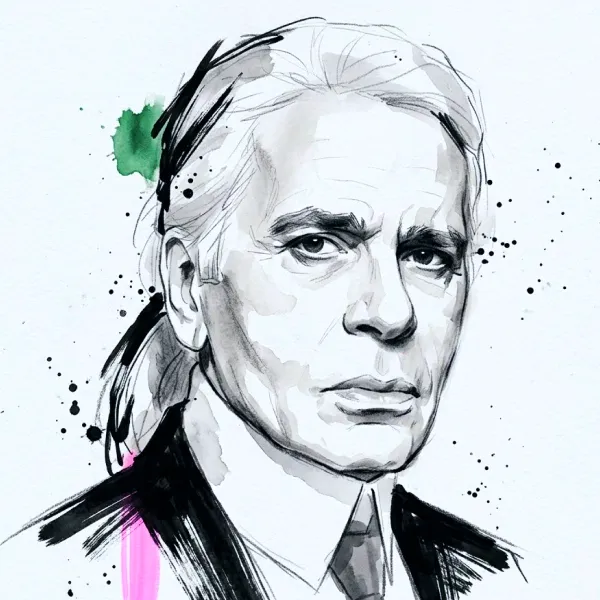
Introduction
Karl Lagerfeld was a German designer, photographer and image-maker whose career was organised around simultaneous authorship at Chloé, Fendi, Chanel and his own label. He worked within Chloé’s multi-designer system from the 1960s, directed Fendi’s fur and womenswear for more than five decades, and learned to move rapidly between distinct house identities without treating any archive as fixed.
Chanel announced Lagerfeld as artistic director on 15 September 1982, effective January 1983. His first haute couture collection appeared on 25 January 1983 and his first ready-to-wear show followed in March 1984. Working with Gilles Dufour, Virginie Viard, Amanda Harlech, the internal ateliers and specialist maisons d’art, he enlarged the house’s graphic codes, built a dual couture and ready-to-wear system, and later established Cruise and Métiers d’art as major presentation formats.
He also photographed Chanel campaigns from 1987 and turned the runway into a large-scale image apparatus, particularly at the Grand Palais. The longevity of the tenure can obscure its institutional character: the output depended on a structured studio, regional executives, acquired workshops and technical specialists capable of converting rapid drawings into collections across several calendars. Lagerfeld died on 19 February 2019, after missing the preceding couture show through illness.
Design ethos
Lagerfeld worked through accelerated variation. At Chanel, tweed, camellias, quilting, chains, two-tone shoes and the interlocking CC were enlarged, miniaturised, layered and moved between clothing, accessories and set design. Archive functioned as a vocabulary to be recombined rather than a set of objects to reproduce.
Graphic clarity held the volume together. Sharp silhouettes, abbreviated hems, dense accessories and emphatic branding allowed couture technique to coexist with denim, sportswear, fetish references and pop imagery. At Fendi the same appetite for transformation was applied to fur; at Chloé it appeared through softer construction, trompe-l’œil and art-historical motifs.
His authorship was inseparable from systems. Drawings established direction, but studio directors, premières d’atelier and maisons d’art determined how speed became material fact. Cruise travel, Métiers d’art themes and monumental show environments extended that method from garment design into a complete cycle of product, image and spectacle.
Disclaimer
Career history
2019
Karl Lagerfeld died on 19 February 2019 after thirty-six years directing Chanel fashion. The house divided his responsibilities between Virginie Viard for fashion collections and Eric Pfrunder for fashion image.
2015
Fendi formalised its highest craft programme as Haute Fourrure in Paris in 2015, extending Lagerfeld’s fur experimentation into couture-scale presentations and Roman monument shows. He remained responsible for womenswear, fur and couture until his death in February 2019.
2015
Fendi launched Haute Fourrure in Paris in July 2015, formalising a couture-level programme built around the house’s fur atelier. The line later adopted the broader Couture title as its material scope expanded.
2002
Chanel established the annual Métiers d’art programme in December 2002 to give the acquired maisons d’art a dedicated commercial and presentation vehicle. The format placed couture-level handwork into an off-calendar, ready-to-wear structure and later became an international destination show.
1992
Silvia Venturini Fendi joined the main studio in 1992 and assumed formal direction of accessories and menswear in 1994. Lagerfeld continued to lead womenswear and fur within a parallel authorship structure that placed apparel and leather goods under distinct creative control.
1992
Karl Lagerfeld returned to Chloé as artistic director in 1992. His second tenure revived fluid slip dresses and art-derived print through a brighter 1990s register before Stella McCartney’s appointment in 1997.
1985
Rome’s Galleria Nazionale d’Arte Moderna hosted Un Percorso di Lavoro for Fendi’s sixtieth anniversary and Lagerfeld’s twentieth year at the house. The exhibition placed the maison’s fur, leather and atelier processes inside a national art museum.
1985
Rome’s Galleria Nazionale d’Arte Moderna hosted Un Percorso di Lavoro for Fendi’s sixtieth anniversary and Karl Lagerfeld’s twentieth year at the house. Garments, fur panels and atelier processes were presented inside a national art museum, giving the house’s craft a formal institutional setting later revisited for its 2026 couture presentation.
1984
Lagerfeld’s ready-to-wear remit became public in March 1984, extending his authority beyond couture. The dual structure made ready-to-wear the commercial engine while couture retained its atelier and image function.
1983
Karl Lagerfeld assumed artistic direction of Chanel in January 1983 after an appointment announced the previous September. He reunited couture and ready-to-wear under a public creative authority and built the house into a multi-calendar system of fashion, accessories, image and spectacle.
1982
Chanel announced Karl Lagerfeld as artistic director on 15 September 1982, effective the following January. The appointment concluded a decade of divided couture and ready-to-wear leadership and introduced the first external head of fashion since the founder.
1977
Fendi’s 1977 launch of women’s ready-to-wear expanded Lagerfeld’s remit beyond fur. The line carried the atelier’s material experimentation into clothing while the house grew through film, licensing and international retail.
1977
Fendi launched women’s ready-to-wear in 1977, extending a house previously centred on fur and leather into a complete fashion wardrobe. The first collection was introduced through Jacques de Bascher’s film Histoire d’Eau.
1975
Chloé’s current archive dates Karl Lagerfeld’s exclusive design appointment to January 1975, after more than a decade within Aghion’s multi-designer studio. The change consolidated collection authorship while retaining the flou, named garments and artistic collaborations developed during the earlier period.
1966
Karl Lagerfeld was promoted to head designer in 1966 after entering Chloé’s collective studio around 1963 or 1964. The promotion marks the shift from shared authorship towards his dominant creative role, preceding the exclusive contract that made him the house’s sole designer in January 1975.
1965
Working with the five Fendi sisters and the Roman fur atelier, Lagerfeld stripped weight and formality from fur, introduced vivid colour and graphic construction, and established the double-F “Fun Fur” mark as the house’s new visual code.
1965
Appointed by the five Fendi sisters in 1965, Karl Lagerfeld transformed fur through colour, lightness and graphic construction, created the double-F “Fun Fur” mark and later directed women’s ready-to-wear and Haute Fourrure until his death in 2019.
1964
Karl Lagerfeld joined Chloé’s multi-designer studio around 1963 or 1964 and gradually became its dominant designer. His first tenure moved from flou dresses and named picture garments to the trompe-l’œil collections presented for Spring/Summer 1983 and 1984, ending when he left for Chanel.
1955
Karl Lagerfeld worked at Balmain as a design assistant from about 1955 to 1958 after winning the coat category of the International Wool Secretariat competition.
You’re in
When the archive opens, you’ll be among the first to know.
That’s all.


